The US embassy in Zim and the Zim embassy in DC said I needed a business visa. When I arrived at the airport, the official told me a different story. I got the business visa for 30 days and they told me NUST could go to Town Hall and get it extended. I told Esabel, my host, quite a few weeks ago that we needed to get on this.
My visa expires Aug 2- Sunday. On Thursday NUST got on it. My Fulbright American friend had said business visas could not be extended. To get around this, I could go to Botswana for 2 days and then enter as a tourist. Botswana is just a bus ride away. I am teaching my class on Wed- Aug 5- so I wasn't really looking forward to a vacation in Botswana this coming week.
Thursday the Registrar finally admitted that he needed to take care of the issue and not HR. He had been copied on all correspondence- way before I arrived - but he never responded.
Thursday morn we drove to Immigration in town. He told me about the dire financial straits of the university. They were informed by the Govt that as of August, they must cover 25% of the budget and as of DEC they need to cover 50%- this includes salaries. The govt sets the price of tuition. The Registrar said that tuition would have to be raised. If it is, students will go on strike. If the university cannot raise the funds in August, faculty will go on strike if they are not paid. There is no one to get money from...businesses are closing all the time. A new executive council was formed; he lamented the political appointees that do not contribute to their efforts. He had just returned from a seminar in Nazareth, Israel! NUST does not get many visiting scholars because they are isolated from the rest of the world. The Registrar was quite open about the deplorable political situation. He appeared to be a real professional - once again, he has to deal with a very frustrating situation.
The same immigration official that was at the airport was in the Bulawayo office. He said I needed a Temporary Work Permit, for the bargain price of $500! I paid $30 for my business visa. I felt quite bad that NUST had to pay this money for me, but it was frustrating that the Registrar did not get involved earlier. He took the forms and we returned to NUST to get the necessary documents and the cash. At 3 pm we returned to the immigration office. Despite the fact that there were 3+ clerks there, we had to wait for our official to return from the airport. Then he said we didn't have everything, but then he admitted that he had told us different information in the morning, so once he saw the $500, he got his stamp working. $5 was requested from me to DHL the packet to Harare on Friday. The plan is that Monday I can show up and he will stamp my passport with an extension.
The US Embassy said that their intern did not renew her visa in time and she went to jail for 5 hours before they got her out. Hopefully everything will go smoothly on Monday. I return on a flight from Vic Falls on Sunday...hopefully all will go smoothly. Looks like I'll visit Botswana another day.
Friday, July 31, 2015

Wednesday, July 29, 2015
Zimbabwean International Book Fair
Monday, July 27 - The ZIBF opened in the Crowne Plaza Hotel in Harare with a traditional ululation. Participants hail from S.A., Ghana, Tanzania, Malawi, US and Kenya. Observed 2 minutes of silence for Zim writers who recently passed away. They were proud to annouce that more books were being published in the local languages. Most students study Shona in school, in my area in Bulawayo they study Ndebele. New Constitution recognizes 16 languages- including sign language.
A student played the violin and recited a poem, followed by a poet performing in Shona. Opening remarks and 3 artistic performers lasted for 1 hour. Sponsors thanked included the Cultural Fund which is supported by the EU, Sweden and Denmark. Tea break! Tables offered teas from different regions.
Sat next to a white woman who cataloged books at the National Gallery. She is writing a book on an Englishman who donated a lot of artwork to various institutions in Zim and S.A. She lives in a nice neighborhood, but residents stopped paying their taxes because they weren't getting city services. As a result, water is not available and goes untreated. As a group they buy water which is delivered to their tank. No water from a tap. They recycle bath water to flush their toilets. They've been doing this for 3 years.
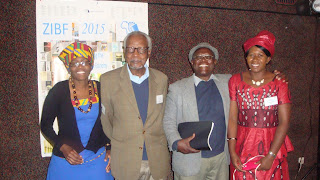
At tea break met a Ndeble writer wearing a stunning traditional hat and dress. I am curious how many Ndeble writers there are, how many books are published and on what subjects. She said she has 7 novels waiting to be published, but the publishers are asking her for money in order to publish her works. She said she would give me the name of her tailor!
Chatted with a man that started a school in a slum. The people were forced to move so he started another school. I told him about the British Council who gives free books to libraries. He also wanted to start mobile libraries in rural areas so I connected him with the Rural Libraries Project.
The Tanzanian keynote stated that governments slap a high VAT tax on local and imported books (not textbooks.) He was disrupted in the middle of this talk by the announcement that the Minister was here. Everyone stands and waits in silence. He is then instructed that he can continue. A few minutes
later the minister enters, keynote speaker finishes and the ministers talks about the revised curriculum.

They want schools closer to the people. Plan to build 2000 schools, looking for partnerships. (Everyone agrees this is pure rubbish because the govt is broke.) The country was just founded in 1980. Curriculum emphasizes building the culture and nation. Heritage Studies is a new subject- want to instill in learners a "consciousness of what we value" - be proud of their heritage, language, natural resources, historic sites, etc. Curriculum based on principles including: inclusivity, gender sensitivity (aka - don't leave out the girls), embrace diversity and transparency.
Infant schools- up to about 4th grade- indigenous language will be medium of instruction. He said their challenge is to convince the parents that this is a good idea because parents think if English is not taught, then it's not a good school. He mentioned that there is a new family structure - due to AIDS crisis, many children are brought up by grandparents. With a population of around 12M (no accurate statistics) I was thinking it didn't make a lot of sense to be teaching 15 languages - need teachers, authors, publishers, etc. When I mentioned this to Gladys (Humphrey Fellow) she was quite insulted that years ago she was forced to learn Shona in school, even though this was not her native language. She said there are 3 dialects of Shona, one being the predominant one. If that one is taught, it is as if the others are considered less important languages. She said the language represents the culture. I would love to have more discussions on this issue.
Secondary schools should teach Drivers Ed - now they need to take private lessons. Will teach French, Swahili, Chinese and Portuguese. [a later speaker criticized this idea- just one African language included. He said Portuguese is non-relevant in the globalized world. Africans should be learning their neighbors' languages.] National pledge will honor those who lost their lives in Chimurenga/Umvukela - the independence wars. Also included, "We are proud creators and participants in our vibrant traditions and culture.
Curriculum will not teach a particular religion, but will teach the moral values of religion. The school pledge includes "Almighty God....."
Sometimes people asked questions in Shona. Questioner commented that "our struggle" was omitted from the pledge- he was referring to the massacre of 20,000 Ndebele people by M in the 1980s. The ministers replied that the committee will determine the final language
Most heated discussions were around copyright and textbooks. Publishers and govt agencies told about catching the violaters and jailing them- including school principals. Other speakers said parents cannot afford the books. There are many copy centers who copy the books. Trich- the white woman sitting next to me- sent me a long email after the conference. She said sometimes circumstances demand that the law be broken. The Ministry determines what textbooks are used. They charge exhoribant prices. That's all people have here is education. They talked about the Kenyan model where there are authorized copy centers and the publishers/authors get a cut.
At lunch I asked about the market for textbooks- asked if they use books from other countries.
The professors said no- context is different. I replied- Math is Math. The retort was Zambia is in a different place (maybe stage of development) than us. But people were talking about regional issues - a woman teaching disability studies at the Open University is doing her PhD in Botswana, remotely.
Interesting session on developing a reading culture. Zim is a very literate society, but students study for the test. Very few read for leisure. Presenter said that a Westerner once said, "If you want to hide something from an African, put it in a book."
A Dr. talked about his Shona Medical Dictionary. He got tired translating for all his relatives. Indigenous languages are not well developed in STEM. Some said this will be irrelevant in a few years because the younger gen knows English. His motivation - language is the basis of self-esteem. Language transmits knowledge and information, as well as values, beliefs and traditions. People have the impression that the white man is smart because we are learning in his language. NUST lecturer did a study in a rural area. Children never owned a book. The teacher was the one with the book, reading in class. No funding for libraries, books were old. Her final comment:"Donate a Book and Make a Difference."
Second day more talk on piracy and the rights of the authors to make a decent living. Poet performed by whitseling what sounded like a folk song - a woman tgot up to dance and then another one came up to dance and sing a song. Poet commented afterward that is was a magical, unexpected moment. Organizer asked for a volunteer to close the conference with a prayer.

A student played the violin and recited a poem, followed by a poet performing in Shona. Opening remarks and 3 artistic performers lasted for 1 hour. Sponsors thanked included the Cultural Fund which is supported by the EU, Sweden and Denmark. Tea break! Tables offered teas from different regions.
Sat next to a white woman who cataloged books at the National Gallery. She is writing a book on an Englishman who donated a lot of artwork to various institutions in Zim and S.A. She lives in a nice neighborhood, but residents stopped paying their taxes because they weren't getting city services. As a result, water is not available and goes untreated. As a group they buy water which is delivered to their tank. No water from a tap. They recycle bath water to flush their toilets. They've been doing this for 3 years.
At tea break met a Ndeble writer wearing a stunning traditional hat and dress. I am curious how many Ndeble writers there are, how many books are published and on what subjects. She said she has 7 novels waiting to be published, but the publishers are asking her for money in order to publish her works. She said she would give me the name of her tailor!
Chatted with a man that started a school in a slum. The people were forced to move so he started another school. I told him about the British Council who gives free books to libraries. He also wanted to start mobile libraries in rural areas so I connected him with the Rural Libraries Project.
The Tanzanian keynote stated that governments slap a high VAT tax on local and imported books (not textbooks.) He was disrupted in the middle of this talk by the announcement that the Minister was here. Everyone stands and waits in silence. He is then instructed that he can continue. A few minutes
later the minister enters, keynote speaker finishes and the ministers talks about the revised curriculum.

They want schools closer to the people. Plan to build 2000 schools, looking for partnerships. (Everyone agrees this is pure rubbish because the govt is broke.) The country was just founded in 1980. Curriculum emphasizes building the culture and nation. Heritage Studies is a new subject- want to instill in learners a "consciousness of what we value" - be proud of their heritage, language, natural resources, historic sites, etc. Curriculum based on principles including: inclusivity, gender sensitivity (aka - don't leave out the girls), embrace diversity and transparency.
Infant schools- up to about 4th grade- indigenous language will be medium of instruction. He said their challenge is to convince the parents that this is a good idea because parents think if English is not taught, then it's not a good school. He mentioned that there is a new family structure - due to AIDS crisis, many children are brought up by grandparents. With a population of around 12M (no accurate statistics) I was thinking it didn't make a lot of sense to be teaching 15 languages - need teachers, authors, publishers, etc. When I mentioned this to Gladys (Humphrey Fellow) she was quite insulted that years ago she was forced to learn Shona in school, even though this was not her native language. She said there are 3 dialects of Shona, one being the predominant one. If that one is taught, it is as if the others are considered less important languages. She said the language represents the culture. I would love to have more discussions on this issue.
Secondary schools should teach Drivers Ed - now they need to take private lessons. Will teach French, Swahili, Chinese and Portuguese. [a later speaker criticized this idea- just one African language included. He said Portuguese is non-relevant in the globalized world. Africans should be learning their neighbors' languages.] National pledge will honor those who lost their lives in Chimurenga/Umvukela - the independence wars. Also included, "We are proud creators and participants in our vibrant traditions and culture.
Curriculum will not teach a particular religion, but will teach the moral values of religion. The school pledge includes "Almighty God....."
Sometimes people asked questions in Shona. Questioner commented that "our struggle" was omitted from the pledge- he was referring to the massacre of 20,000 Ndebele people by M in the 1980s. The ministers replied that the committee will determine the final language
Most heated discussions were around copyright and textbooks. Publishers and govt agencies told about catching the violaters and jailing them- including school principals. Other speakers said parents cannot afford the books. There are many copy centers who copy the books. Trich- the white woman sitting next to me- sent me a long email after the conference. She said sometimes circumstances demand that the law be broken. The Ministry determines what textbooks are used. They charge exhoribant prices. That's all people have here is education. They talked about the Kenyan model where there are authorized copy centers and the publishers/authors get a cut.

At lunch I asked about the market for textbooks- asked if they use books from other countries.
The professors said no- context is different. I replied- Math is Math. The retort was Zambia is in a different place (maybe stage of development) than us. But people were talking about regional issues - a woman teaching disability studies at the Open University is doing her PhD in Botswana, remotely.
Interesting session on developing a reading culture. Zim is a very literate society, but students study for the test. Very few read for leisure. Presenter said that a Westerner once said, "If you want to hide something from an African, put it in a book."
A Dr. talked about his Shona Medical Dictionary. He got tired translating for all his relatives. Indigenous languages are not well developed in STEM. Some said this will be irrelevant in a few years because the younger gen knows English. His motivation - language is the basis of self-esteem. Language transmits knowledge and information, as well as values, beliefs and traditions. People have the impression that the white man is smart because we are learning in his language. NUST lecturer did a study in a rural area. Children never owned a book. The teacher was the one with the book, reading in class. No funding for libraries, books were old. Her final comment:"Donate a Book and Make a Difference."
Second day more talk on piracy and the rights of the authors to make a decent living. Poet performed by whitseling what sounded like a folk song - a woman tgot up to dance and then another one came up to dance and sing a song. Poet commented afterward that is was a magical, unexpected moment. Organizer asked for a volunteer to close the conference with a prayer.

Saturday, July 25, 2015
The Safari

I was so surprised to see so many white tourists at the bus station. The bus was heading to Victoria Falls, the most popular tourist attraction in the country. I met Josh and Katy who were going on the same game drive as me. They were on World Missions- 9 countries in 9 months, doing volunteer work in various agencies. In Bulawayo they worked in an orphanage. I sat next to a Zambian. He told me Africans in sub-Sahara Africa in the SADC can visit neighboring countries for up to 3 mos without a visa.
After 3 1/2 hrs I disembarked at the Safari Lodge in Hwange National Park, among the top national parks in Africa in terms of sheer numbers and variety of game. With over 108 species, Hwange boasts the highest diversity of mammals of any national park in the world.
I made reservations with the park service to stay in Main Camp. I then registered for a game drive with Africa Wanderers.
At the Safari Lodge we met Ty, our guide, He drove us to Main Camp. Josh and Katy were camping, I rented a cottage with ensuite toilet. We arrived in the dark at 6:15, the gate was already closed. But they let us in and said we would register tomorrow.
My room was just fine, very basic Reminded me of the platform tents in Yosemite. I didn't want the luxury experience. I thought I would meet more locals. We were cautioned not to walk around at night- sunset is at 6 pm. The fences consist of chicken wire with many broken down posts. Ty said I would make it safely to the restaurant with my flashlight.


Mid-week things were pretty quiet. There were 2 couples at the restaurant. I joined a German couple. He was studying in Tanzania, she was working for a NGO. She had worked in Bulawayo for 4 months with an agency distributing food to people with AIDS in 2010. In 2010 (?) the grocery store shelves were empty. In some ways the situation has improved- the shops are full. However she says she is left with more questions about the country. She has no answers to the problems.
My room included a man starting a fire in a rather crumbling fireplace outside my door, but he started at 7 am. So they guys in the restaurant heated hot water in the microwave for my coffee.

We were off at 8 am- 4 people joined us from another group- 1 Italian, 1 English and an American couple. We were in an open air jeep- 3 benches. The temp. was in the 60s, but in the jeep the wind was really blowing. They claimed that because it was winter, the animals were waking up later- waiting for the warmth. We didn't see too many animals early on. (People who went on early morning drives at 6:30 also came back sometimes without seeing anything.) Ty stopped to pick a wild plant called Bushman's soap. You add a bit of water and it's a moisturing soap. Showed us an elephant's skull and teeth. There is trophy hunting in the park; all the proceeds go back to the park. Hunters can hunt 2% of the population of a species. The meat goes to local orphanages.

Elephant population estimates vary widely from 20K-75K. There are no fences so the animals roam from Botswana as far as Angola. There is a big debate about culling the population. The elephants do huge damage to the vegetation. Ty said they are losing 1000 elephants every year. They drink 200 liters a day. There is not enough water or food for them. When the park was founded, they dug water holes. Now some of them are solar-powered. With the dire economic situation, they don't always have fuel or manpower to maintain the watering holes. NGOs also finance them. They tend to maintain the waterholes near tourist sites, so the elephants are concentrated in these areas. If they were more spread out, there would be less destruction to the environment. Some say they should rotate the maintenance of the waterholes to prevent environmental destruction. But then that would hurt the tourist industry. Cooperation with neighboring countries is also advocated. More transfrontier parks are needed. When they cull, they must destroy the whole heard, otherwise the elephant remembers and will return and be violent. There are not enough professioinals who know how to destroy the herd. Recently 23 elephants were sold to China which created a huge outcry. Saw lots of elephant turds before we say the real thing. Every 15 min. they drop- they don't process their food well. Because of the sandy environment, elephants have a short lifespan here - 65 - 70 years. The sand is tough on their teeth.

During the day, we saw: zebra, elephants, giraffes, impalas (they roamed around the camp,) kudus, steembu (pigmy antelope,) sable, hippo (just submerged in the water,) 2 crocodiles, secretary bird, ostrich, gnu, arthog and black back jackals. We did not see lions. We would not see rhinos because of the poaching. The Chinese think the horn has special powers. They pay 50-100K for 1 kg- worth more than cocaine or gold. 750 were lost to poaching last year. A horn can fetch $1M. People risk their lives to kill the animals- they could get $10K. Ty was thinking they could be extinct shortly. There are only 2 in the park, in a protected area, under 24-hr guard.


Not sure 9 1/2 hours was worthwhile, but it was interesting seeing different parts of the park. We went off road, on to dirt paths. One moment in a grove to thick trees, the next in open fields. Our pit stop was at a camp ground. 2 elderly couples rented out the whole place. They had tents with cots. The spot had toilets. They brought their own solar mini panels to power their fridge so they could have cold beers. The caretaker had a hut to live in. He made sure they had water and firewood. He locked the gate each evening, even though the fence was torn in areas. Like campers world over, they enjoyed the experience. Sat their with their binoculars- knew all the birds. Came 3 times a year. Again, these guys were white. The park does bring school children for camp outings, so maybe the younger generation will learn to love the outdoors.

We stopped at a watering hole with a viewing stands. Our picnic lunch was cut short due to the bees. I brought lots of bug repellent with deet, but never used it. My camera battery died just when all the elephants were 50 yards from us. One crossed the road in front of us, turned to face us, lifted his foot as if he was doing a jig, then sauntered off. Josh will send me his pictures.

We had the option of a night drive. I was tired. The jeep is very bumpy. Thought the odds of seeing a lion were pretty low. Turns out the drive was cancelled due to truck malfunctioning. Here is a solar-powered watering hole

Next morning on our way to the bus, stopped at Painted Dog Sanctuary. The guide gave us a good tour. They wild dogs get trapped in the wire traps of the poachers. Population is down. They have a dog hospital. They put collars on the dogs. Artists make sculptors out of the salvaged wire.
Bus arrived early at 9:50, back to Bulawayo by 1:20. I will post pictures when the computer cooperates- so check back again.
Friday, July 24, 2015
The land grabs continue
This evening at synagogue I saw Kate. She had returned from her conversion in Maryland. Her father has a farm with oranges. The government wants to confiscate it. They have 150 workers and a school on the farm. There is some law that whites can own less than 150 hectares. They own 120, so they are fighting th eviction.
I could tell the guy saying kaddish tonight was Israeli. After services I talked with Shai and his wife. They are on their 1 1/2 month honeymoon in Africa. They gave me good advice about visiting Vic Falls. They stayed at the place I have booked. They told me to see the river by canoe- a guy padels, I just sit and drink.
I'm not allowed to walk home in the dark. The gentleman who brought me home told me they are also trying to take his farm. I asked about the recent announcement that the govt is inviting farmers back. He said it's rubbish, but may relate to those farmers in Zambia who are growing wheat and maize that Zim now imports. He said there are massive grain silos in Harare that when the whites were farming were always full. Now they are totally empty.
On his farm he had 300 giraffes that he used for photographic safaris. He said they have now all been slaughtered for meat. The govt is desperate for cash.
He is fighting his takeover. He says he wants to be able to give his farm to his black workers. He has cattle. They have hoof and mouth disease now so he cannot sell them. If the takeover could be delayed by a year, the cattle would recover and then he could sell them and take the money. All the machinery would be given to his workers.
He said he had a foundry that he sold for a lot of money. But when the govt converted the currency to dollars, he lost all his savings.
I asked how are things going to get better. He said the black Zimbabweans are the cream of the crop. But right now they are gutless. They are not standing up to the corruption. I said they're scared they could be killed. He said certainly that is the case in this area, where M. massacred 20K people in the 80s. He said it is not just M. The party is corrupt. To get anything done, you need to bribe. He said the land grabs are just showing people that you can get something by not working for it. He actually said that he thought M wife could be good because she can control things. I didn't exactly follow that train of thought. He also said the oppostion- who I thought were the good guys- ordered a large shipment of T-shirts and did not pay for them...now the business is going bankrupt.
He said the NGOs are problematic. Near him, some charity is giving all the children bicycles, but the education system is atrocious. The NGOs want to keep their jobs. Many of them have very nice homes.
When I asked him what the US could do to improve things- he said bring in advisors to teach the people about good goverance and the rule of law. The new constitution means nothing if there is no law enforcement. Then he mentioned that the African society respects the elders- even if the elder is totally corrupt. So, in short, there are many factors and it will take a long time to change things. The man's daughter is in Australia. He and his wife will have residency there. But, he said the move would be hard for him. His family came to Zim 3 generations ago from Lithuania.
I'm so glad I decided to go to services tonight!
I could tell the guy saying kaddish tonight was Israeli. After services I talked with Shai and his wife. They are on their 1 1/2 month honeymoon in Africa. They gave me good advice about visiting Vic Falls. They stayed at the place I have booked. They told me to see the river by canoe- a guy padels, I just sit and drink.
I'm not allowed to walk home in the dark. The gentleman who brought me home told me they are also trying to take his farm. I asked about the recent announcement that the govt is inviting farmers back. He said it's rubbish, but may relate to those farmers in Zambia who are growing wheat and maize that Zim now imports. He said there are massive grain silos in Harare that when the whites were farming were always full. Now they are totally empty.
On his farm he had 300 giraffes that he used for photographic safaris. He said they have now all been slaughtered for meat. The govt is desperate for cash.
He is fighting his takeover. He says he wants to be able to give his farm to his black workers. He has cattle. They have hoof and mouth disease now so he cannot sell them. If the takeover could be delayed by a year, the cattle would recover and then he could sell them and take the money. All the machinery would be given to his workers.
He said he had a foundry that he sold for a lot of money. But when the govt converted the currency to dollars, he lost all his savings.
I asked how are things going to get better. He said the black Zimbabweans are the cream of the crop. But right now they are gutless. They are not standing up to the corruption. I said they're scared they could be killed. He said certainly that is the case in this area, where M. massacred 20K people in the 80s. He said it is not just M. The party is corrupt. To get anything done, you need to bribe. He said the land grabs are just showing people that you can get something by not working for it. He actually said that he thought M wife could be good because she can control things. I didn't exactly follow that train of thought. He also said the oppostion- who I thought were the good guys- ordered a large shipment of T-shirts and did not pay for them...now the business is going bankrupt.
He said the NGOs are problematic. Near him, some charity is giving all the children bicycles, but the education system is atrocious. The NGOs want to keep their jobs. Many of them have very nice homes.
When I asked him what the US could do to improve things- he said bring in advisors to teach the people about good goverance and the rule of law. The new constitution means nothing if there is no law enforcement. Then he mentioned that the African society respects the elders- even if the elder is totally corrupt. So, in short, there are many factors and it will take a long time to change things. The man's daughter is in Australia. He and his wife will have residency there. But, he said the move would be hard for him. His family came to Zim 3 generations ago from Lithuania.
I'm so glad I decided to go to services tonight!
Wednesday, July 22, 2015
Where I live and work


Mobile Book Truck
Monday morning I joined the Public Library's Mobile Library team as they visited 4 schools. I was surprised when they drove to my neighborhood, one of the richest in the city. Similar to other places in the world- the rich people send their kids to private school. This school is all black, many of the students are the kids of the caretakers and cooks. Most if not all homes have a shed where the help live.
The mobile library's offerings are meager. The books are organized sort of by grade level, but each time the truck moves books fall off the shelves. A single red string holds the books in place on one shelf.
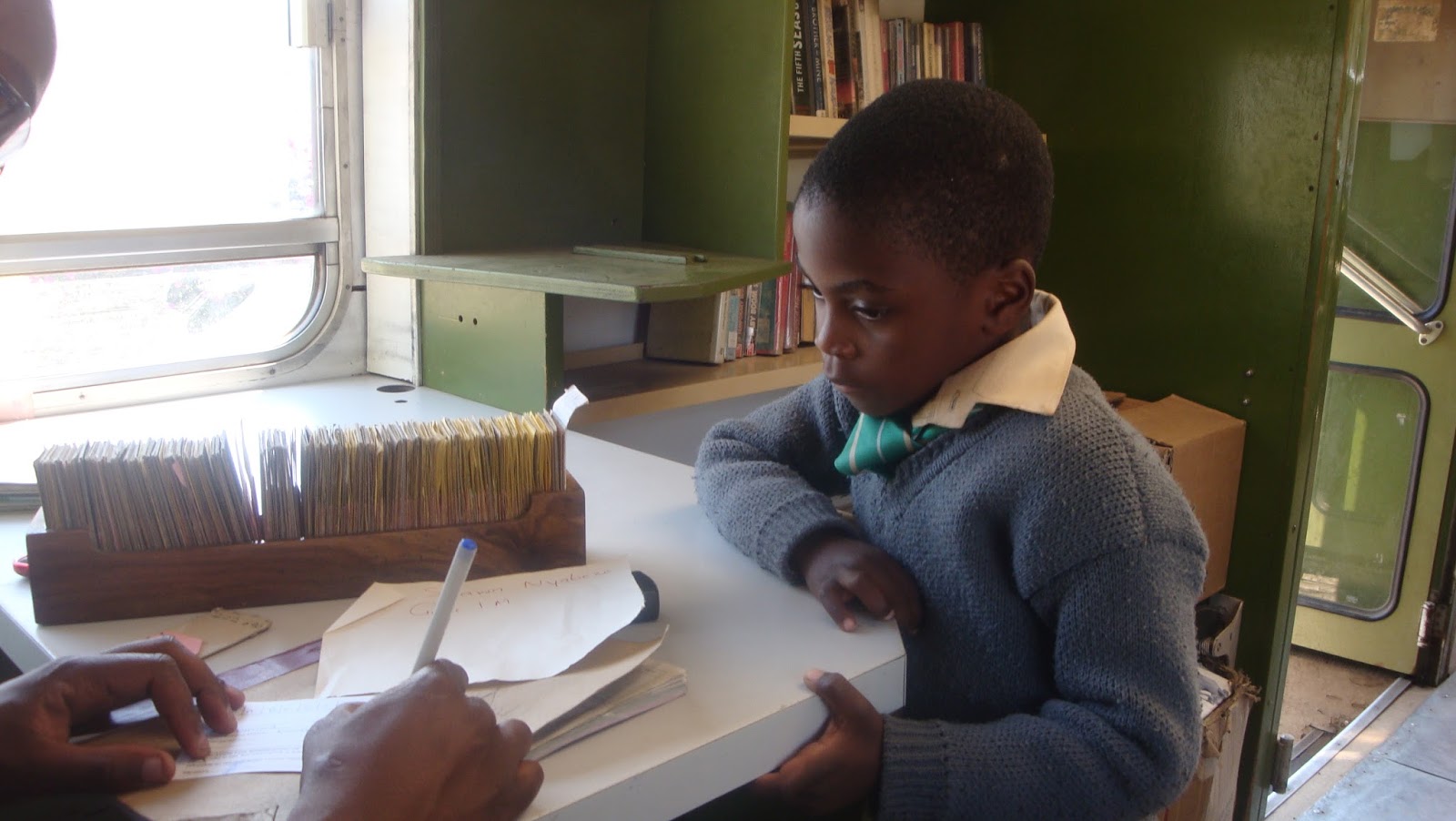
The students must pay $4 per term (3 mos.) to check out 1 book for a fortnight. If they checked out more, there would not be enough books for all. Hence <50 borrow books out of 1000 students. We parked in the yard and the kids seemed to be going in the opposite direction, but soon they started appearing, with books in hand. The librarian spends his time checking out books and only advises kids when he spots a young child check out a difficult book. Then he instructs him to go choose another book.
I think the kids were rather surprised to see me, but they told me a bit about the books they had read and the subjects they like to read about.


 The kids wearing the blue sweaters were situated just 20 min. from the city, but quite a rural area. Goats wandered into the school yard. I saw kids around some tables outside, thinking it's a nice day, the teacher decided to hold class outside. When I chatted with the headmistress, she said due to overcrowding, some classes are held outside. Class size is 35-45 students.
The last picture with the thatched roofs is a school for the disabled. The picture after the bookmobile is the teacher helping her students select a book. Teachers were surprised to hear that they could check out books for free.
It's too bad that Nozipho does not have time for some programming. He desires to fix up the bus and get better materials. Still, all the kids were smiling, happy to have books to read. But, seems like he needs more time to market this service. I've been invited back next week to go to the High-Density suburbs (aka: the slums.)
The mobile library's offerings are meager. The books are organized sort of by grade level, but each time the truck moves books fall off the shelves. A single red string holds the books in place on one shelf.
The students must pay $4 per term (3 mos.) to check out 1 book for a fortnight. If they checked out more, there would not be enough books for all. Hence <50 borrow books out of 1000 students. We parked in the yard and the kids seemed to be going in the opposite direction, but soon they started appearing, with books in hand. The librarian spends his time checking out books and only advises kids when he spots a young child check out a difficult book. Then he instructs him to go choose another book.
I think the kids were rather surprised to see me, but they told me a bit about the books they had read and the subjects they like to read about.




The last picture with the thatched roofs is a school for the disabled. The picture after the bookmobile is the teacher helping her students select a book. Teachers were surprised to hear that they could check out books for free.
It's too bad that Nozipho does not have time for some programming. He desires to fix up the bus and get better materials. Still, all the kids were smiling, happy to have books to read. But, seems like he needs more time to market this service. I've been invited back next week to go to the High-Density suburbs (aka: the slums.)
When elephants fight, just the grass is harmed
Innocent is the new guest in the guest lodge. He is from Harare, teaching Taxation to undergraduates. During our dinner conversation last night, he mentioned how the sanctions are only hurting the people, not the politicians at the top. Sanctions close down factories and businesses resulting in high unemployment. His solution to the economic mess is that Western countries should be training the locals on civil governance so they can confront their leaders. Right now, the leaders blame the economic slowdown on the sanctions. Innocent says they hide behind the sanctions and attribute all the problems to the sanctions. If the sanctions were lifted, they would have no excuse and they would be forced to explain to the people why they are in such a desperate economic state.
We got on this topic when I mentioned that Jimmy Carter monitors elections. Innocent said Zim would never accept an outsider to monitor their elections. He mentioned their new constitution that now has an anti-corruption unit as well as an independent election commission. He said that when westerners try to come in, they always suspect that they have a hidden agenda.
Gladys, who teaches civic education, also said that M. is trying to pit the Southern Hemisphere against the North. She said she understands where he is coming from. He's head of the African Union. Sort of like Chavez- he's saying enough is enough. We in the global south can stand up for ourselves. They don't want northeners/Westerners coming in to tell them what to do.
It is a sad state of affairs because it is like a pot ready to boil over. There is so much pent up energy. People are educating themselves. They are aware of what is going on outside of their country. However, with no money, they are stagnating. An infusion of advisors and exchange programs to empower the people could transform this place. Right now they are intimidated. The security forces are very strong. A Human Rights activist has disappeared and there is a lot of talk about his whereabouts. The French Ambassador called for an investigation and he was called to the Foreign Ministry to be reprimanded. On the US Embassy site there is his picture and the Ambassador is demanding his release.
Innocent said their proverb is, "When elephants fight, only the grass is harmed." That's how he describes what the US (and other countries) sanctions are doing to Zimbabwe.
We got on this topic when I mentioned that Jimmy Carter monitors elections. Innocent said Zim would never accept an outsider to monitor their elections. He mentioned their new constitution that now has an anti-corruption unit as well as an independent election commission. He said that when westerners try to come in, they always suspect that they have a hidden agenda.
Gladys, who teaches civic education, also said that M. is trying to pit the Southern Hemisphere against the North. She said she understands where he is coming from. He's head of the African Union. Sort of like Chavez- he's saying enough is enough. We in the global south can stand up for ourselves. They don't want northeners/Westerners coming in to tell them what to do.
It is a sad state of affairs because it is like a pot ready to boil over. There is so much pent up energy. People are educating themselves. They are aware of what is going on outside of their country. However, with no money, they are stagnating. An infusion of advisors and exchange programs to empower the people could transform this place. Right now they are intimidated. The security forces are very strong. A Human Rights activist has disappeared and there is a lot of talk about his whereabouts. The French Ambassador called for an investigation and he was called to the Foreign Ministry to be reprimanded. On the US Embassy site there is his picture and the Ambassador is demanding his release.
Innocent said their proverb is, "When elephants fight, only the grass is harmed." That's how he describes what the US (and other countries) sanctions are doing to Zimbabwe.
Subscribe to:
Posts (Atom)